This route is built for two full days. Day one is on foot, and everything in it fits inside the triangle between the fortress, the seafront and Highland Park. Day two needs a car: the three main sights outside the city lie in opposite directions from Baku, and there is no public transport between them.
The timings below are approximate. In winter it gets dark around five in the afternoon, so the evening stops shift an hour or ninety minutes earlier.
Day one: the fortress, the sea and the sunset
09:00. Icherisheher
Head out early, before the heat and the tour groups. Icherisheher is the walled old city, a UNESCO World Heritage Site. People still live inside it: laundry dries in the courtyards, cars are parked by the doorways.
The layout is medieval and some lanes are around a metre and a half wide. Getting lost is easy, but the fortress is small, and within forty minutes you will reach a wall in any direction.
Along the way you will pass the Juma Mosque, several caravanserais converted into restaurants, and rows of shops selling carpets and copperware. Haggling is expected here, and the first price quoted is usually inflated.
Stop at the Maiden Tower. It stands around 28 metres tall, with walls up to five metres thick at the base. Its original purpose is still debated, with theories ranging from defensive to religious. There is a viewing platform at the top overlooking the bay and the rooftops of the old city.
10:30. The Palace of the Shirvanshahs
The residence of the rulers of Shirvan, with most of it built in the 15th century. The complex is made up of several separate structures: the palace itself, the burial vault, a mosque with a minaret, a bathhouse, and an octagonal colonnaded pavilion, the divankhane, variously described as a courtroom or a reception hall.
Allow an hour. The palace sits at the highest point of the fortress, so from here the walk runs downhill towards the sea.
12:30. Baku Boulevard and Little Venice
The seaside boulevard runs along the Caspian for several kilometres. Along it you will find Little Venice, a network of canals with bridges and boats built in the 1960s. A boat ride takes about fifteen minutes. The Ferris wheel nearby takes roughly twenty minutes for one rotation, and the view from the top covers the whole sweep of the waterfront.
This is also the place to stop for lunch. Prices on the first row facing the water run higher than two blocks inland for comparable food. The general price level across the city is covered in our breakdown of prices in Baku.
14:30. The Azerbaijan National Carpet Museum
The building is shaped like a half-rolled carpet and stands directly on the boulevard. Inside are carpets from different schools: Baku, Guba, Shirvan, Ganja, Karabakh and Tabriz. Each group comes with an explanation of how density, ornament and colour differ.
An hour is enough.
16:00. The Taghiyev Mansion and the National Museum of History
About fifteen minutes on foot uphill from the boulevard, on Taghiyev Street. The mansion was built between 1893 and 1902 to a design by Jozef Goslawski, and Hajji Zeynalabdin Taghiyev gave it to his wife, Sona Khanum. The building occupies an entire block. Inside are state rooms with carved panelling, mirrors and chandeliers brought from France and Germany.
Taghiyev was the first major Azerbaijani patron and philanthropist. His money opened the first secular school for Muslim girls in Baku in 1901. He funded the Shollar water pipeline that first brought clean drinking water to the city, built a theatre, paid for students to study abroad, and commissioned the first translation of the Quran into Azerbaijani.
The mansion was confiscated in 1920, and since 1921 it has housed the National Museum of History of Azerbaijan. The collection covers the country from archaeological finds through to the 20th century, though half the impression here comes from the interiors themselves. We cover the mansion and its rooms in a separate article.
Allow an hour and a half.
18:00. Highland Park
Go up about forty minutes before sunset. The climb on foot is steep, so a taxi or the funicular from the boulevard is easier.
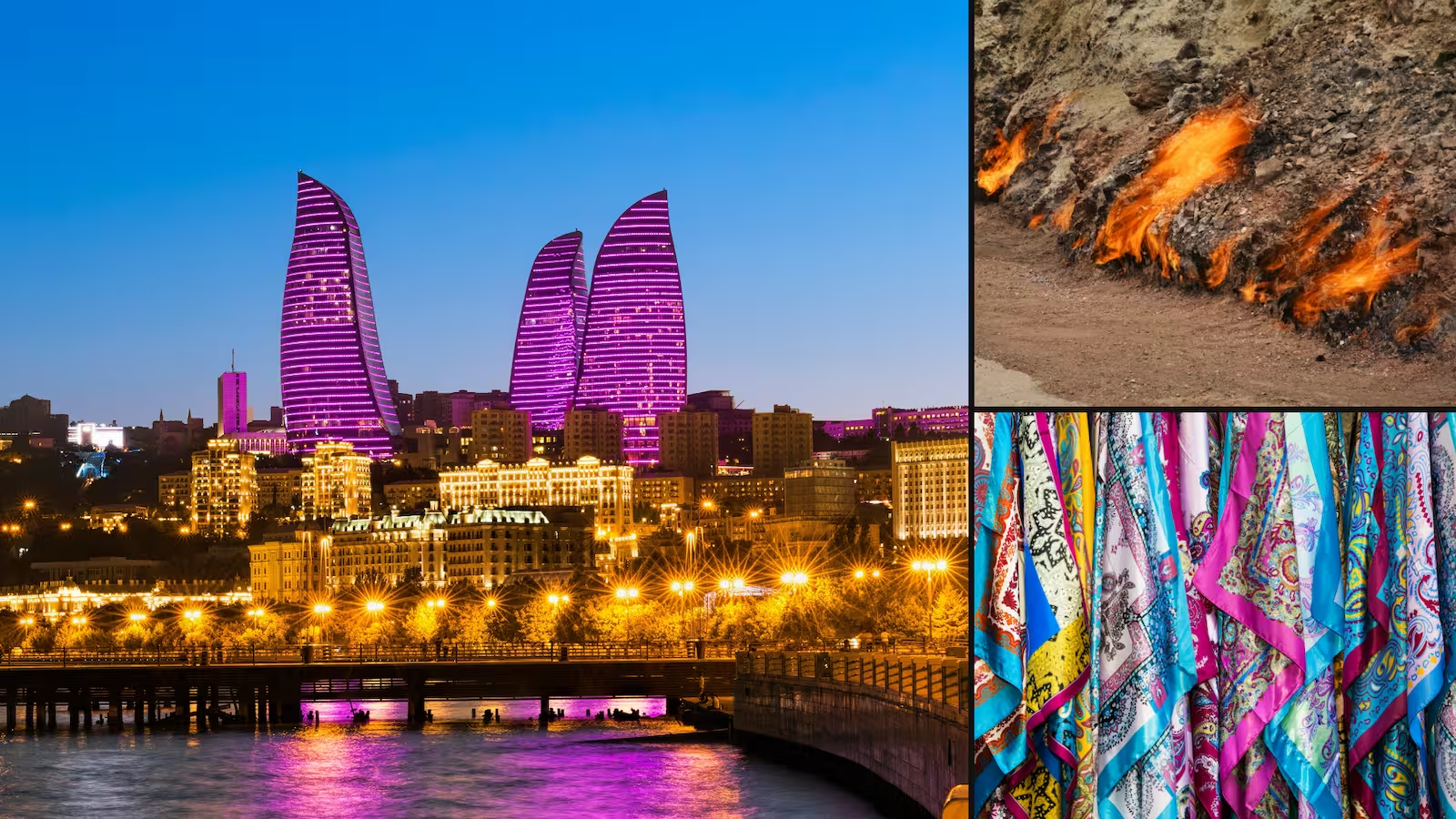
From the top you can see the whole bay, the waterfront and the Flame Towers. On the way you will pass the Alley of Martyrs, a memorial to those killed in January 1990 and in the Karabakh wars. It is an active memorial site, and photo shoots and loud conversation are not appropriate there.
After sunset the towers light up. The walk back down takes about twenty minutes.
Day two: Zaha Hadid, petroglyphs and fire
Day two is built around two trips out of the city. It does not work without a car for the whole day, and the reasons are set out at the end.
09:00. The Heydar Aliyev Center
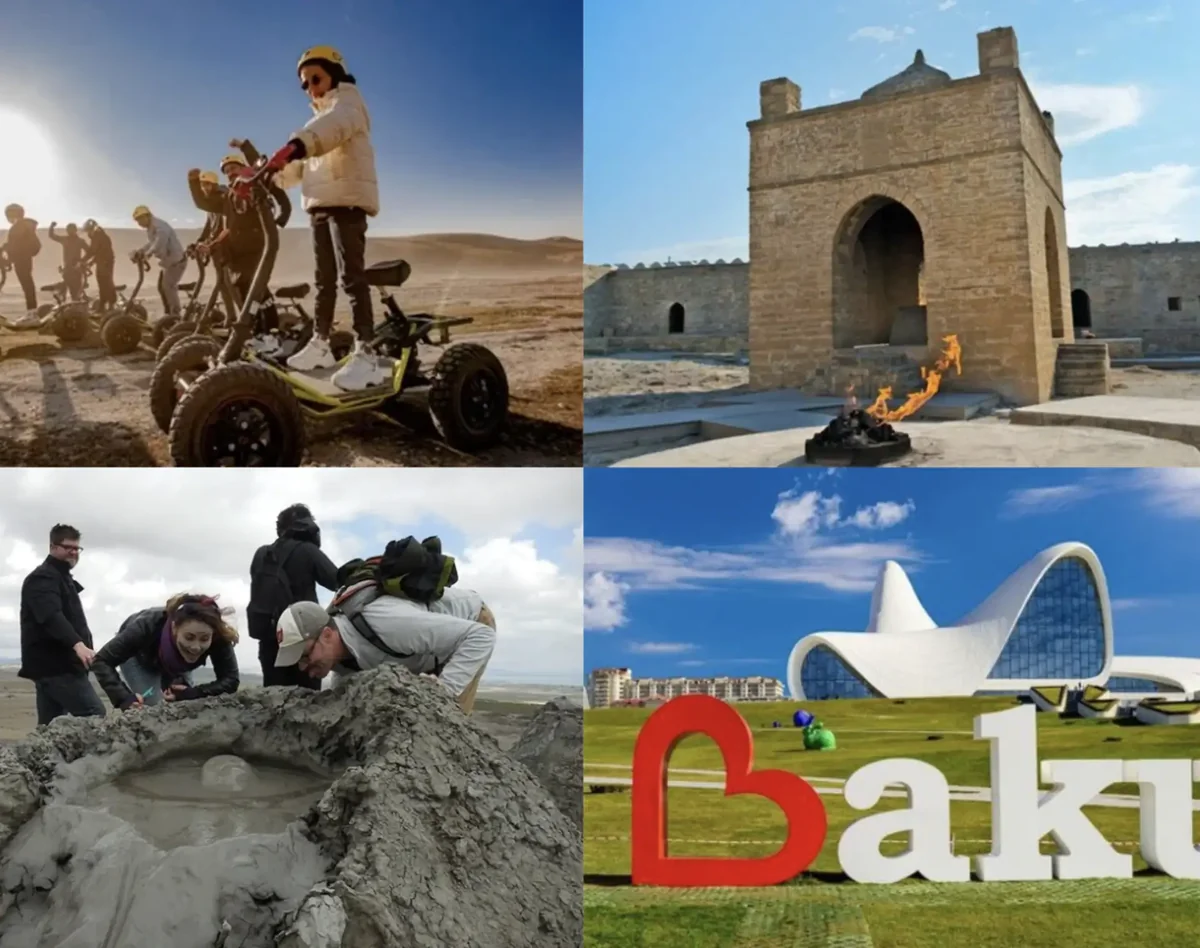
A Zaha Hadid project, opened in 2012. The building has no right angles, and the wall flows into the roof with no visible boundary.
Inside are several permanent exhibitions, including a collection of vintage cars and a hall of miniature replicas of Azerbaijani architectural landmarks. We cover the building and its exhibitions in more depth in a separate article.
Arrive at opening time: the first hour is noticeably quieter, and you have a lot of driving ahead of you today.
10:30. Yashil Bazaar
The Green Market, about fifteen minutes from the centre. Dried fruit, nuts, pastila, local cheeses, pickles, spices, and pomegranates and persimmons in season. Tasting is offered almost everywhere, and prices are negotiable.
Pick up something for the road, because lunch today will be late.
11:30. Gobustan
About 65 kilometres south, roughly an hour along the coastal highway. Gobustan Reserve is a field of rocks covered in petroglyphs, around six thousand of them, with the oldest estimated at tens of thousands of years. The subjects repeat: boats with rowers, hunters, bulls, goats, and chains of dancing figures.
Start at the museum by the entrance. It is modern, with interactive screens, and half an hour there gives you the context that makes the trail between the rocks read properly.
The site is on the UNESCO list. There is almost no shade on the route, so water and a hat are essential.
13:30. The mud volcanoes
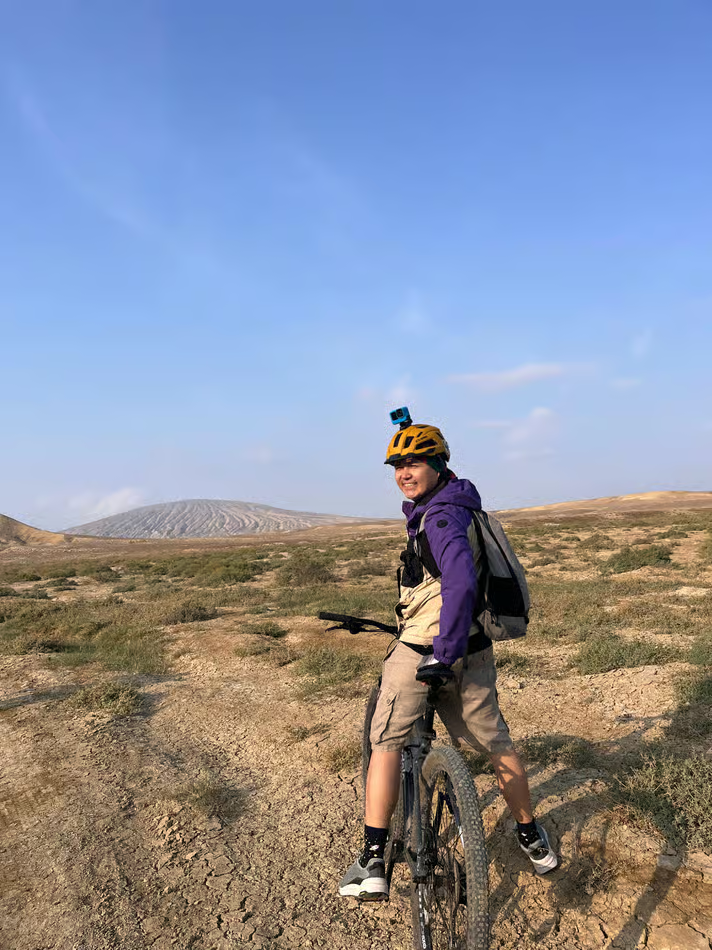
About twenty minutes from the reserve, but the asphalt runs out before that. An ordinary car cannot go further, so local drivers wait at the turning in old off-roaders: they take you up to the plateau and wait there, with the waiting time included in the price.
On the plateau there are dozens of cones roughly waist high. Grey clay bubbles up out of them. It is cold, with no heat at all. We cover them in more detail in a separate article.
Clothes get dirty and the clay does not wash out well.
15:00. A stop for qutab
On the way back, pull in at a roadside cafe. Qutab are thin flatbreads of unleavened dough, fried on a dry pan and folded in half. The filling is your choice: herbs, pumpkin, meat or cheese. They arrive in a stack, brushed with butter, eaten by hand and often dusted with sumac.
There is a separate guide to the rest of the local cuisine.
17:00. Ateshgah
Now turn northeast, back through the city and on to Surakhani. Ateshgah is a pentagonal temple complex with an open altar in the courtyard where a flame burns. Around the perimeter are the cells where pilgrims lived, with inscriptions in Sanskrit and Punjabi on the stone slabs.
Zoroastrians came here, as did Hindu pilgrims travelling with the trade caravans. The natural gas vent ran dry at the end of the 19th century, and the gas is now piped to the altar.
18:30. Yanardag
Twenty minutes from Ateshgah. Yanardag is a hillside with natural gas escaping from it, and the line of fire burns there continuously. In daylight the flame is barely visible against the sun, so it is worth arriving at dusk.
The viewing platforms are built up and you can stand close. Half an hour is enough.
20:30. Nizami Street and Fountain Square
Back to the centre. Nizami Street, which everyone in the city calls Torgovaya, is a pedestrian run of shops, cafes and street musicians. It opens onto Fountain Square.
The evenings here are busy, and most cafes stay open past midnight. If you still have the energy, it is ten minutes on foot from the square down to the waterfront, and the lit Flame Towers are seen best from there.
How not to break day two
Gobustan lies southwest of Baku, while Ateshgah and Yanardag are northeast. They are on opposite sides of the city, the day adds up to roughly two hundred kilometres, and you have to drive through the centre twice.
What follows from that:
Hire a car with a driver for the whole day. Separate taxis for each leg will not work, because there is nowhere to find a ride back at the mud volcanoes.
Public transport does not cover this route. A bus runs to Gobustan but not to the volcanoes, and there is no direct connection between Gobustan and Absheron.
If you have less time, cut a whole trip, not minutes. Either Gobustan with the volcanoes, or Ateshgah with Yanardag. Doing one trip properly beats rushing both.
A ready-made tour removes the logistics. Almost every operator runs Gobustan and Absheron, sometimes on the same day: tours from Baku.
Worth knowing in advance
Wind. It blows almost constantly on the boulevard and in Highland Park. A windbreaker is useful even on a July evening.
Cash. Cards work almost everywhere in the centre. At Yashil Bazaar, with the off-road drivers and at roadside cafes you will need manats. You can work out the amounts in the currency converter.
Connectivity. You will need navigation constantly on day two, and roaming is expensive. Local SIM and eSIM options are covered here.
Where to stay. The easiest base is between Icherisheher and Fountain Square: day one is entirely on foot, and day two is simpler to start from the centre. Options are collected on this page.
Shoes. Cobblestones in the fortress, a stone trail at Gobustan, stairs in Highland Park.
If you have a third day, the logical continuation is Sheki or Gabala. Both need an overnight stay, as the drive one way takes three hours or more.