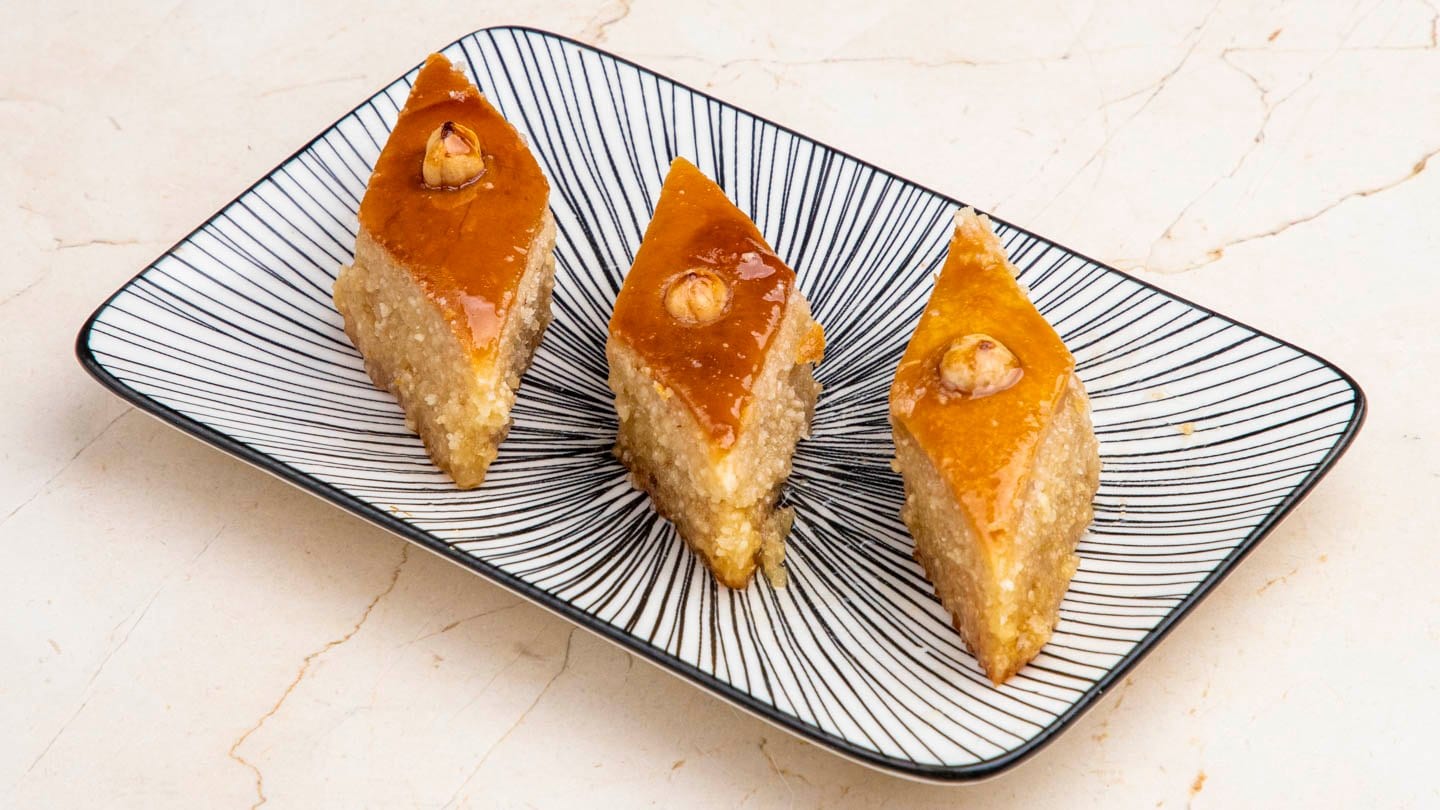
Pakhlava
Pakhlava (paxlava) is a layered pastry of thin dough, walnuts, and honey or sugar syrup, cut into diamonds and flavoured with cardamom. It is the crown of Azerbaijani sweets, especially at Novruz.
What is Pakhlava?
Pakhlava (paxlava) is Azerbaijan's most famous sweet: many thin layers of dough, brushed with butter, with a filling of ground walnuts (or almonds), sugar, and cardamom. After baking, it is soaked in a honey or sugar syrup. It is cut into diamond (romb) shapes and often decorated with a nut half on each piece. It is central to Novruz and to any festive table in Baku and across the country.
How do you eat Pakhlava?
Pakhlava is eaten in small pieces one diamond per serving with tea (çay). It is rich and sweet, so one or two pieces with strong black tea is typical. It is served at room temperature, often on a shared plate. Use a fork or your hands; it is sticky from the syrup.
What are the main ingredients of Baku Pakhlava?
Thin dough (yufka-style, like phyllo), melted butter between the layers, a filling of ground walnuts (sometimes with almonds), sugar, and cardamom. After baking, a syrup of sugar (or honey), water, and sometimes lemon or rose water is poured over. So: flour, butter, walnuts, sugar, cardamom, and syrup. Baku pakhlava is often made with a specific number of layers (e.g. 10) and a diamond cut.
The Celestial Symbolism
Baku Pakhlava is not just a dessert; it is an ancient astronomical symbol. Together with Shekerbura and Qoghal, it forms the "celestial triad" of the Novruz spring holiday. The diamond shape (romb) specifically represents a star or the ancient symbol of fire (fitting for Azerbaijan, the "Land of Fire"). The single nut pressed into the center of each piece symbolizes a spark of life or a seed, representing fertility and the rebirth of nature in spring.
The Copper Sini Tradition
Authentic Baku Pakhlava is traditionally baked in massive, heavy copper trays called "sini". The process is incredibly labor-intensive. A true master rolls out 9 to 12 individual layers of dough so thin that you can read a newspaper through them. Each microscopic layer is generously brushed with melted butter before the thick layer of cardamom-spiced nuts is added in the middle.
Ingredients
- Flour
- Walnuts (or almonds)
- Butter
- Sugar
- Honey
- Cardamom
- Egg
- Lemon or rose water (optional)
Frequently asked questions
- How is Azerbaijani Pakhlava different from Turkish Baklava?
- Azerbaijani pakhlava often has a diamond (romb) shape and is made with more layers; the filling is usually walnuts with cardamom. Turkish baklava is often cut into rectangles or triangles and may use pistachios and a simpler spice profile. Both use thin dough and syrup; the shape, nut choice, and spice (cardamom in Azerbaijan) are the main differences.
- Why is Pakhlava cut into diamond shapes?
- The diamond (romb) shape is traditional in Azerbaijan and is said to resemble a stylized star or the eye it has symbolic value at Novruz and on festive tables. Cutting into diamonds also makes portioning easy and gives a recognisable look. In Baku, diamond-cut pakhlava is the standard.
- How do the layers stay so crispy under the syrup?
- The secret lies in thermal shock. Traditional bakers follow a strict rule: if the baked Pakhlava is piping hot right out of the oven, the sugar-honey syrup poured over it must be completely cold (or vice versa). This temperature difference stops the dough from turning soggy, ensuring the bottom layers absorb the sweetness while the top layers remain incredibly flaky and crisp.